On the Occasion of
World Day Against Child Labor
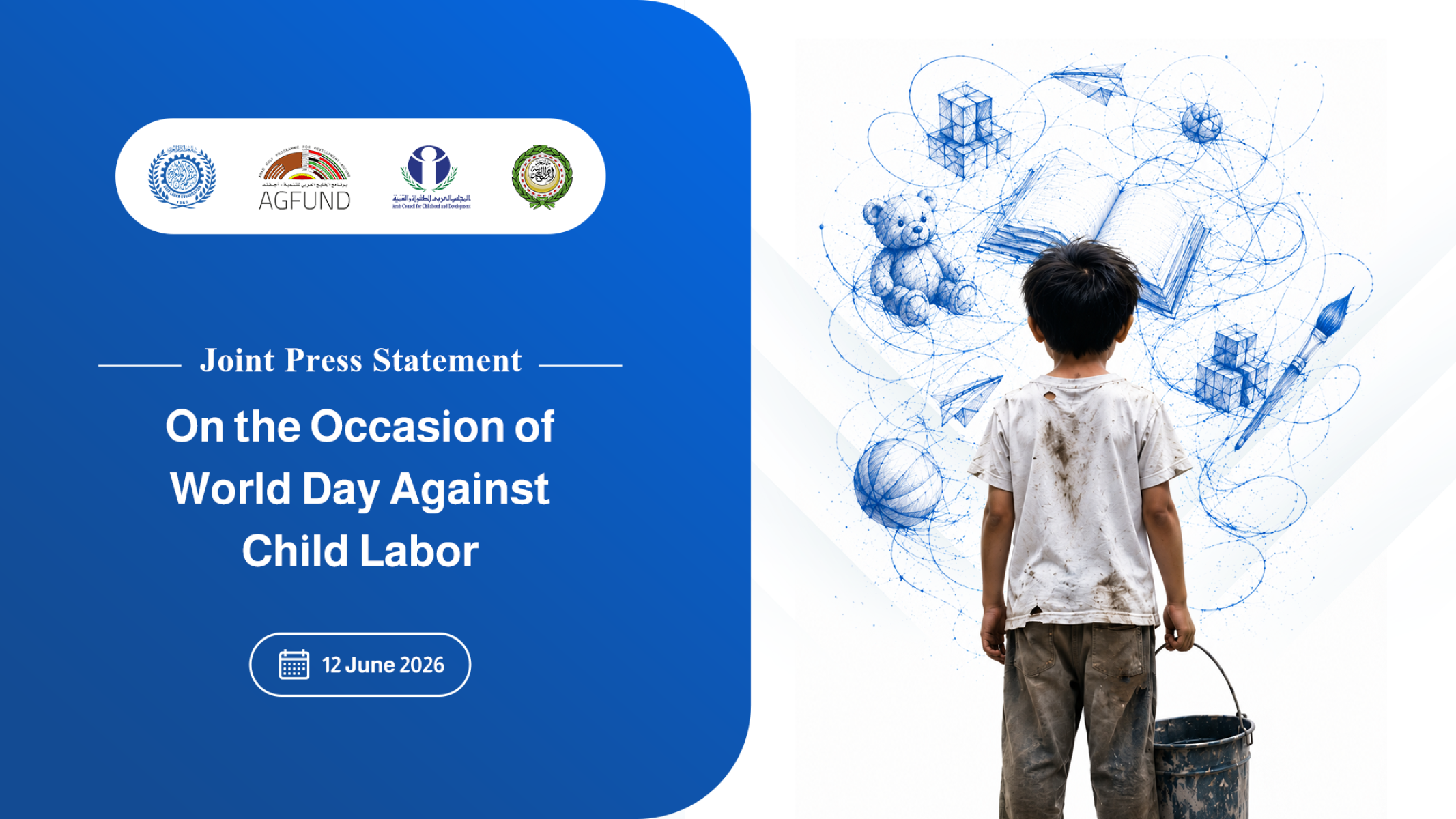
12 June 2026
On the occasion of the World Day Against Child Labor, observed annually on 12 June, we, the General Secretariat of the League of Arab States, the Arab Labor Organization, the Arab Council for Childhood and Development, and the Arab Gulf Programme for Development (AGFUND), reaffirm that the elimination of child labor is both a moral imperative and a development priority. It is a true measure of the effectiveness of development policies, the fairness of social systems, and the capacity of societies to safeguard childhood in an era marked by growing poverty, conflict, and vulnerability. We further reaffirm our unwavering commitment to intensifying efforts to eliminate child labor in all its forms, particularly its worst forms, and to advancing the protection and promotion of children's rights in accordance with relevant international standards and conventions.
The observance of this year’s World Day Against Child Labor comes at a critical moment, as growing challenges continue to impede progress towards achieving the global target of ending child labor as enshrined in Sustainable Development Goal Target 8.7. Recent international estimates indicate that approximately 138 million children remain engaged in child labor worldwide, including 54 million children involved in hazardous work that threatens their health, safety, and development. These alarming figures reflect the compounded effects of poverty, conflict, climate change, economic instability, and social crises, all of which continue to undermine efforts to protect children and secure their future.
Across the Arab region, concerns over the persistence and expansion of child labor are intensifying amid increasingly complex and overlapping crises affecting families and communities. The ongoing regional conflict in the Middle East, protracted wars and armed conflicts, displacement and refugee movements, deteriorating economic conditions, rising multidimensional poverty, the expansion of informal employment, weakened education systems and social protection mechanisms, and declining access to decent work have all heightened children's vulnerability to exploitation. These factors continue to drive increasing numbers of children into the labor market at an early age, often in hazardous and exploitative conditions. Such realities, compounded by shortcomings in protection, monitoring, referral, and reintegration mechanisms, constitute serious violations of children's rights and undermine the principles of social justice and decent work.
In the context of rapid digital transformation, the risks associated with child labor are no longer confined to traditional sectors and occupations. Emerging digital environments have created new and increasingly complex forms of economic exploitation and abuse through online platforms, applications, and digital services. Efforts to eliminate child labor must therefore address these evolving risks by strengthening policies and safeguards that foster a safe and child-centered digital environment, one that respects children's rights and protects them from all forms of commercial exploitation, and economic abuse. Such efforts are essential to fulfilling international commitments aimed at eradicating child labor and ensuring that every child enjoys a safe, secure, and dignified childhood.
Against this challenging regional backdrop, the plight of children in the Occupied Palestinian Territory, particularly in the Gaza Strip, remains among the most distressing examples of grave violations of children's rights in our time. The devastating consequences of the ongoing war, including displacement, deprivation of food, shelter, education, and healthcare, have created an unprecedented humanitarian catastrophe for children. Palestinian children face daily threats to their right to life and development, compounded by the loss of social protection, disruption of education, and increased exposure to exploitation and hazardous labor. This situation calls for urgent and effective international action to ensure their protection, end violations against them, and uphold their rights in accordance with international humanitarian law and the Convention on the Rights of the Child.
Recalling the conclusions of the High-Level Arab Conference on Child Labor and Social Protection Policies in the Arab States, convened by the partner organizations in Cairo in December 2025, we reaffirm that the elimination of child labor requires comprehensive and integrated approaches that address its root causes. Such approaches must be anchored in inclusive, resilient, and crisis-responsive social protection systems, particularly in communities affected by conflict, displacement, disasters, and other emergencies.
We further commend the outcomes of the Second World Summit for Social Development held in Doha in 2025, particularly the Doha Political Declaration, as well as the outcomes of the Sixth Global Conference on the Elimination of Child Labor held in Marrakech in 2026, notably the Marrakech Framework for Action. These important milestones have reinforced the global commitment to accelerating the elimination of child labor and advancing social justice. They underscore that ending child labor is an urgent moral and developmental obligation that cannot be deferred, and that no child should be left vulnerable to poverty, conflict, or structural inequalities.
On this occasion, we reaffirm the following strategic priorities:
In conclusion, we reaffirm that the elimination of child labor is indispensable to the achievement of social justice and Sustainable Development. We remain committed to working in partnership with Member States of the League of Arab States and all relevant stakeholders to advance integrated and evidence-based policies that address root causes of child labor and ensure that every child enjoys the right to protection, quality education, and a life of dignity.
Let us join forces to end child labor. Our children deserve a future that reflects their aspirations, nurtures their talents, and enables them to thrive.
12 June 2026
An AI-powered inquiry service based on the Council's accumulated knowledge.